Sunday, April 30, 2017

TOW #27: "Taxes will go up. Here’s why."

              This article was posted by The Washington Post. Although this outlet has faced criticism from conservatives regarding its reliability, this article is an editorial and demonstrates only the author’s thoughts. The author, in this case, is Robert J. Samuelson. He has been a reporter since the 1960s. In this particular article, he addresses the issue of taxation in America. As the title indicates, Samuelson believes that taxes are bound to go up. He states that, despite Trump’s tax reform promises, and growing conservative reaction from Americans, we are on course to need money in the government, and taxes will be raised.
              The author begins the article with a very direct statement. He says, “Let’s be clear: America is an undertaxed society.” This establishes the principle behind his thesis. Taxes will go up because, above all, they are too low. Later, he adds to why we “need” more tax with why we should “want” more tax. He talks about tax relief and says, “tax relief would go to low- and middle-income households with children — a deserving group.” It is hard to justify denying impoverished children the money they need to survive, and so the natural desire to help others would incline us to use more tax money.

              Ultimately, the question of taxation is going to be a polarizing one. It pits the wealthy against the poor. The wealthy argue that handouts will remove the work ethic of the poor and discourage them from working. However, the same argument could be made that tax cuts for the wealthy reduce their work ethic because it would allow them to make more money off less work. It really comes down to decency. No society should be able to sleep at night knowing that so many didn’t eat dinner. However, it is up to those not eating to prove they are worth feeding.

https://www.washingtonpost.com/opinions/taxes-will-go-up-heres-why/2017/04/30/830294d6-2c45-11e7-b605-33413c691853_story.html?utm_term=.d390ea1f838b

Sunday, April 23, 2017

TOW #26: Why aren't people listening to scientists?

http://www.latimes.com/opinion/op-ed/la-oe-dusautoy-march-for-science-20170423-story.html

              This article is written appropriately after the march for science. This was a time for people to voice their concerns about the general decrease in respect for science in America, particularly by the latest presidential administration. The article was written by Marcos du Sautoy of the Los Angeles Times. This is a very well-respected organization. The article discusses several instances in which the public, at least part of it, has dismissed the word of scientists. Perhaps the most profound example of this is the anti-vax movement that has led to an increase in measles cases. This movement not only went against the word of the scientific community but also against what should be common sense.
              The rhetoric of this article is affective because it is able to acknowledge this legitimacy of the anti-science side, which may not appear to have any credibility at first. One example of this is when the article states “sometimes science goes against intuition.” This may seem obvious, but to someone with very little intellectual ability, it is a reason to discredit science. A more understandable rationale that the article provides is the idea that scientists may act in self-interest. For instance, they may publish false information in order to bring attention to themselves. This suspicion has led to countless conspiracy theories.

              Ultimately, the article is preaching to the choir. The people in this country who choose to ignore the word of people who research professionally are too ignorant and miserable to be affected by an article criticizing them. This article is simply yet more reason for the educated to feel superior to groups such as anti-vaxxers. The only place where this article may have any effect is in the Trump administration, a target of the march for science. The people in there may be willing to listen, and we better hope they are.

Wednesday, April 5, 2017

IRB Intro #4

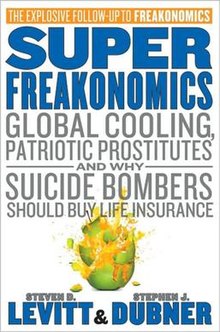
Image result for superfreakonomics

The time to select the last IRB of the year has come, and I have chosen Steven Levitt and Stephen Dubner's Super Freakonomics". My first IRB, the one that I read in the first marking period, was Freakonomics. I figured I would be able to see improvement in myself by comparing my analysis of two similar books from the beginning and ends of the year. Like the first Freakonomics, Super Freakonomics discusses the statistical ideas of unusual phenomena.

Sunday, April 2, 2017

TOW #25: "Where Humans to Go Extinct, Should the Species Be Revived?"

              This article was written by Laura Geggel, a senior writer for LiveScience.org. The article summarizes a recent debate between some of the country’s top scientists. The debate was moderated by renowned astrophysicist Neil deGrasse Tyson. The debate was over the subject of “de-extinction.” Specifically, should humans be brought back after they have gone extinct. The article discusses certain scenarios such as an alien civilization coming to Earth and reviving humans. However, in this scenario, the scientists, somewhat unanimously, opt for no de-extinction as humans would likely be kept in zoo-like habitats.
              The article itself is a string of anecdotes from the debate. It synthesizes soundbites and quotes into a concise yet continuous summary of the dialogue from the debate. It switches between pro de-extinction and anti-de-extinction perspectives and opinions from the participating scientists. It groups the opinions and quotes into ethical concerns and lawful concerns. Such an example is “Yes, we do, said panelist George Church, a professor at Harvard University and the Massachusetts Institute of Technology, who is working on reviving bits and pieces of the woolly mammoth. But then again, Church, a geneticist, molecular engineer and chemist, has often opined that the science of de-extinction is already here or within reach, and should be pursued.”

              Perhaps the biggest flaw in the article was its failure to address what, to me, was the first question to enter my mind, “How can we revive ourselves if we are all dead?” The article does mention a few plausible scenarios (such as the alien revival I mentioned earlier) but it seems that the soundbites and quotes are addressing other situations. An explanation was needed but never provided. Otherwise, the organization of the essay was perfect. It balanced the perspectives given and grouped them into different concerns. Hopefully we will never have to come to de-extinction but it’s nice to know we have a good understanding if we do.

Sunday, March 26, 2017

TOW 24: "Liar's Poker" Part 2

              In the second half of Michael Lewis’s “Liar’s Poker,” he explores the struggles and downfall of Salomon brothers, the banking firm Lewis had worked at. In my last TOW, I had complained about the discontinued anecdote of the Liar’s Poker game played between Merriweather and Gutfreund. While I was let down in expecting it at the end, Lewis’s story is forgivable due to its extremely satisfying conclusion. Lewis perfectly builds up a detestable image of his superiors (and indeed everyone on Wall Street) and has them put in their place by the 1987 Wall Street crash.
              Before Lewis gives the antagonists the smack down, he articulates his position on Wall Street very well. He credits his mentors through an antithesis. He credits his current mentor, Dash, as being “across his desk.” He credits his original mentor, Alexander, as the one “across the ocean.” He also quotes his peers’ metaphors about him. They describe Lewis with sexual innuendos in order to indicate that his stock-trading abilities are desirable to a sexual extent, and some of his body parts are accordingly desirable. Ultimately, Lewis successfully makes himself out to be likeable person in a sea of nightmares.

              Lewis’s ability to put himself in this position makes the ending extremely satisfying. In the stock market crash of the winter of 1987, nearly everyone he works with is fired. Except, of course, for Lewis himself. It is great to see that, no matter how rich and powerful people like Gutfreund are, they are no match for the economy of a country. Finally, Lewis goes on to quit his job. His reason is that one’s salary should reflect how much they give to society. As a bond-trader, Lewis failed to see any contribution that justified how much money he was making. Lewis rescues his character and shows that money is not everything.

Sunday, March 19, 2017

TOW 23: WikiLeaks does Americans no favors

              This editorial was written by Reading Eagle News Agency about the impact of WikiLeaks on America. It seems that the article was written in response to recent fears about the CIA spying on American citizens in their homes. These fears exploded recently when videos of people asking their home devices such as Google Home or Amazon Alexa if they were connected to the CIA, and the devices responded by shutting off. Since then, Americans have feared for their privacy. The writers discuss this fear of privacy and how WikiLeaks, to some extent, holds the answer.
              The writer begins by stating that WikiLeaks has released over eight thousand documents and that not one hint the CIA is spying on American Citizens. Obviously, the writer implies that WikiLeaks not saying it means it isn’t happening. If the CIA were to be spying on American citizens, WikiLeaks would’ve said something about it. The author then argues that the CIA’s ability to spy on cell phones and computers is comforting. Knowing that the CIA can gather intelligence on potential dangers, even if the ability may be used on citizens, is favorable to the CIA lacking the ability altogether.

              This particular editorial is somewhat incoherent. Firstly, the fears of the CIA hacking and spying on citizens are somewhat unfounded as proven hastily by the author of this piece). However, there are rising fears of corporate espionage against customers that are much more legitimate. Recently, Samsung issued a warning to its customers to not discuss personal matters near their Smart TV. Clearly, the microphone in the TV is permanently on, and Samsung records its customers in order to gain information. Google and Facebook are notorious for selling their customers privacies for their own profit. It would be simply too easy for these companies to be corrupted and for the last of our privacy to be sold for money.

http://www.readingeagle.com/news/article/editorial-wikileaks-does-americans-no-favors

Sunday, March 12, 2017

TOW 22: Why we should not know our own passwords

              This editorial was written for phys.org by Megan Squire, an experienced software engineer. The article, being centered around software conflict, is perfectly in Squire’s field of knowledge. Squire is a professor of computing sciences at Elon University and she obtained her Ph. D from Nova Southeastern University. Her article discusses the rising issue of privacy vs security. Many customs agents are demanding more and more access to both immigrants’ and travelers’ devices. Understandably, travelers are trying to devise ways to circumvent this invasion of privacy. Squire talks about the various methods of doing so and why the travelers have the right to practice it.
              Starting in 2009, US customs have been given permission to search electronic devices carried by citizens. This includes the right to demand citizens’ passwords. One idea that Squire and many other software developers (including the team at Google) came up with was referred to as the “I’d love to comply, but I can’t” solution. The idea was that a user’s password is something they know subconsciously, but is actually unable to share with someone else. Squire compares this to a musician who has perfected their muscle memory. They can play the song, but can’t tell someone the order of the notes they play. This security feature is extended by locking out the user if it detects irregular patterns in the user’s habits (this means someone other than the user could not use it without being locked out).

              Squire’s general argument, although never directly stated, is strongly implied: the customs searches are immoral and should be fought. She recognizes that the fight against them is borderline illegal, and addresses the real-world situations in the last paragraph. She reminds the reader that lying to the agent is the worst thing they could do. If you ever feel that your privacy is threatened, comply to the agent before seeking a digital civil liberties group. 

https://phys.org/news/2017-03-passwords.html