Sunday, October 23, 2016

TOW #6: The largest methane leak in U.S. history began one year ago at Aliso Canyon. What have we learned since then?


              In this editorial, the author shares the story of the largest leak of methane gas in United States history. It happened in Aliso Canyon, California and it released more than 90,000 metric tons of the potent greenhouse gas. The article later describes the negative effects that it had on neighboring residents. This particular piece was written by The Los Angeles Times Editorial Board. This group is comprised of nine individual writers who have each gained years of experience in, our outside of The Los Angeles Times.
              This article was written for an indefinite audience. The issues present have the ability to impact each and every person in the country on a profound scale. The writing is used to persuade readers into taking their own actions to increase the currently insufficient progress being made. This article was written after the worst methane leak in the history of the country. Not only did it force nearby citizens to relocate due to the methane’s impact on their health, but it caused an energy shortage. Furthermore, it was written during a time period in which the effects of fossil-fuel addiction are becoming ever more apparent.

              The author begins the text with an anecdote of how the leak came about. They describe how the leak was thought to be small and routine. The author’s then use a litote and say “the leak was neither small nor routine.” Implying that the leak was profound while also instilling a sense of uncertainty and dread. This is much more effective than presenting the 90,000 metric tons statistic at the beginning. Without context, the statistic is meaningless to the reader. The authors proceed by appeal to readers’ emotions. They tell the story of the 8,000 families forced to relocate due to the sickening smell of the gas.” In fact, residents in the surrounding area still experience frequent nausea, nosebleeds, and even rashes. The authors also tell how the fear of widespread power-outages would have caused the state to grind to a holt had it not been for a summer of unusually low power-usage. These stories appeal to fear. If the facts regarding fossil fuels’ danger did not convince readers to take action, the fear of the consequences of over-dependence will.

Sunday, October 16, 2016

TOW #5 "Obama Calls for New Cooperation to Wrangle the ‘Wild West’ Internet"

              This article discusses President Obama’s recent comment that he internet has become “the wild wild west.” He made these comments during a gathering in Palo Alto, California. He spoke alongside figures like Tim cook, the CEO of Apple. Together, they proposed ideas as to how major corporations and intelligence agencies might share information in a more protected way. The report on the events were given by Nicole Perlroth and David E. Sanger. Combined, these two have written over 5,000 articles for The New York Times.
              It is quite clear that this article was written for the modern audience. The issue of cyber-security is a profound and rapidly-changing one. The ways in which we, as a society, handle the developing threats are critical to keeping the information of the world safe. The New York Times, like all media, benefits from attention and thus would be hasty to write an article that appeals to people’s fears. The article states that Obama chose to have the event around Stanford University because it is largely acclaimed to be the birthplace of the internet.
              The most prevalent rhetoric is Obama’s metaphor of the internet being like the wild west. This metaphor is extended by the idea of major corporations being asked to take the role of Sheriff. The article’s commentary on the events display sarcasm towards the end of the report. While quoting many of the figures who spoke at the event on how important trust between the corporations and intelligence agencies is to maintaining a safe cyberspace, the article mentions how “intelligence agencies were surreptitiously siphoning off customer data from companies like Google and Yahoo as it flowed internally between their data centers.” Tis is made particularly effective by its juxtaposition to a quote from the Vice-President of security at Google, who said, “The tricky thing with information-sharing is that it is about trust, information-sharing becomes pretty hard to do once trust is lost.” The purpose of this sarcasm was to show that there is still a large amount of work to do in order to achieve the goal of safety, and the authors prove it with the goals themselves.

Sunday, October 9, 2016

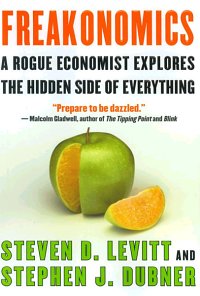
TOW #4: "Freakonomics" by Steven B. Levitt and Stephen J. Dubned (Part One)

              Why are schoolteachers like sumo wrestlers? What makes the KKK similar to a group of real-estate agents? Why do drug dealers live with their moms if they make so much money? These are the main topics of conversation discussed in the first half of Steven D. Levitt and Stephen J. Dubned’s Freakonomics. The authors, both being economists, attempt to explain seemingly inexplicable phenomena through the lens of economics. All the issues explored are used to answer a question, “How do humans respond to incentives?”
              Although the questions mentioned above are the main focuses of the first three chapters, the authors’ analysis involves the discussion of many other issues. In fact, the entire book is simply a collection of anecdotes used to answer the topic question of each chapter. One that was particularly interesting was the story of Paul Feldman. After showing how even some of the most acclaimed professions such as school teachers and sumo wrestlers can, and do, cheat, Levitt and Dubned answer a pressing question, “Are all humans innately corrupt?” The answer to this question lies in the story of Paul Feldman, a bagel salesman. Essentially, Feldman would drive to an office building early in the day, drop off a basket of bagels and a money jar, and come back to pick them up in the evening. This would seem to be a horrible plan as most customers would just take a bagel without paying, but astonishingly, Feldman’s income averaged roughly 87% of his bagel sales.

              This particular anecdote epitomizes the authors’ purpose. As seemingly impossible outcomes are presented, the reader begins to change the way they think. Not only does the reader think about how human’s act, but how we, both individuals and society as a whole, evaluate ourselves. This book shows how complex an issue can be even when there appears to be a certain right and wrong. In response to the bagel story, the authors explain “If morality represents the way we would like the world to work, and economics represents how it actually does work, then the story of Feldman’s bagel business lies at the very intersection of morality and economics.” As humans, we are wired to think about situations morally, but Freakonomics shows that the human way of thinking is fundamentally flawed.

Sunday, September 25, 2016

TOW #3 9/25


              This political cartoon shows an iPhone (evidently a generation 5 or later), symbolizing millennials, with an iPhone charging cord (for generation 4 or earlier) is labeled as Hillary Clinton. This cartoon was published in The San Diego Tribune. Although their political bias is often debated, The San Diego Tribune is generally thought of as a conservative-leaning newspaper. This is likely to be the reason why it featured a cartoon meant to mock Hillary Clinton, the Presidential nominee for the opposing political party. The cartoon was also published to show why millennials overwhelmingly sided with Bernie Sanders and not Hillary Clinton earlier in the 2016 race.
              This cartoon was most likely made for millennials. This is evident in the fact that the author uses iPhone charging ports to symbolize the disconnection between Clinton and millennials. A younger audience would understand this much quicker than an audience of adults. The idea behind the cartoon is that Hillary is too old-fashioned and too traditional. This means that she has not been in line with the way that young voters think. Her rival for the nomination, Bernie Sanders, expressed a passion for new ideas that attracted the majority of young voters. The artist is able to demonstrate this in the cartoon by depicting Hillary as an out-of-date chord, and the millennials as the newest iPhone.
              The main device that the artist uses in this cartoon is objectification. They objectify both Hillary and millennials. The objectification of Hillary as an outdated (at least to the millennials) charging chord represents that her way of thinking is not compatible with theirs. Evidently, the artist is correct. Young voters overwhelmingly sided with Bernie Sanders. However, if the author’s purpose was to criticize Hillary Clinton, they were not entirely successful. The young voters that this cartoon applied to have become Hillary supporters, for the most part. The metaphors used in the cartoon applied specifically to this younger audience, and they seem to have moved on from what it ridicules.

Sunday, September 18, 2016

TOW #2 9/18

Trump Makes his Birther Lie Worse

This article discusses the most recent story surrounding Donald Trump. Earlier in Trump's campaign, he made hints and claims that Barack Obama was not born in the United States. These hints actually began with Trump’s first campaign in 2011. This weekend however, he claims that Obama was, in fact, born in the U.S. He then pointed fingers at his opponent Hillary Clinton, saying she began the rumor that Obama was not. The article was written by Gail Collins. She has worked for The New York Times for twenty-one years and was the first woman to hold the position of “Editorial Page Editor.”
The New York Times has a predominately liberal audience, and because of this, one would expect negative bias to be present in an article discussing the republican presidential nominee. However, the article is mostly composed of quotes said by Trump himself. The only bias that is present is the author’s response to those quotes. She uses sarcasm throughout the article. She quotes Trump from 2011 when he said “Three weeks ago I thought he was born in this country. Right now I have some real doubts. I have people that actually have been studying it, and they cannot believe what they’re finding,” she then remarks that “We never did learn what they found. But Trump has continued to get some of his most startling information from ‘people’.” She uses sarcasm later when responding to a quote from Former Mayor of New York, Rudy Giuliani, that Trump had changed his mind two or three years ago. Collins points out that this is the same time that Trump tweeted “How amazing, the State Health Director who verified copies of Obama’s ‘birth certificate’ died in plane crash today. All others lived.”

It is clear that Collins has an opinion about Donald Trump, and not a positive one. She is also writing to a mostly-liberal audience. Her prolonged sarcasm is used to make Trump look unintelligent to support her own ideas as well as satisfy the liberal audience. Her sarcasm, although used with bias, is based entirely off of facts. Trump did say all the things Collins sarcastically quotes him of saying and he said them when she says he said them. This makes Collin’s article extremely effective. If someone were to refute her work in defense of Trump, they would first have to attack Trump’s words.

Sunday, September 11, 2016

TOW #1 9/11

Tow #1

Article - VW Engineer Pleads Guilty in U.S. Criminal Case Over Diesel Emissions

            This article showcases the recent events concerning the Volkswagen emission scandals that were uncovered in 2015. The popular car company was caught cheating on emissions tests by including software that would decrease nitro-oxide emissions when it detected the car was being tested at the expense of efficiency. Specifically, it mentions the recent confessions made by Volkswagen engineer James Robert Liang, who recently pleaded guilty. The author, Hiroko Tabuchi, has been writing about Business for The New York Times for eight years. In 2013, she won the Pulitzer Prize for Explanatory Reporting.
            It seems this article was written for people concerned about the future of Volkswagen. The author’s style of writing, however, appeals more to an audience wanting to see the giant topple. This article was written almost a year after the scandal was first discovered by the public, which has given writers enough time to gather what they need to disgrace the German carmaker. The author uses these gatherings to contribute to her scornful tone. She includes quotes from VW executive’s emails that read “regulators are still waiting for Answers. We still have no good explanations!!!!!” This particular quote is included to make the executives of Volkswagen seem desperate and childish.

            The author then quotes the chief of the Justice Department’s Environmental Crimes Section who says that this was “the first shoe to drop”. This idiom means that there is an inevitable next step in the process and that Volkswagen will have to endure, and that Volkswagen is destined to lose the battle. The author villainizes Volkswagen at the end of the article by saying that the prosecutor’s office of Lower Saxony, a town in which Volkswagen powers most of the economy, was reluctant to comment. It would be impossible to deny that Volkswagen is in the wrong and so it is relatively easy for the author to villainize them in this article, and Tabuchi is certainly successful in portraying them that way.

Wednesday, September 7, 2016

IRB #1

I have chosen to read "Freakonomics" by Stephen J. Dubner and Steven Levitt for my first IRB. This popular piece applies principles of economics to everyday situations such as parenting and cheating. I have been recommended this book more times than I can remember and I am finally getting it off my bucket-list. I think it will strongly appeal to my love for math and science and make for a great read!